
Neurofeedback Therapy: Training Your Brain Through Real-Time Feedback
Learn how Neurofeedback Therapy uses real-time information about brain activity to support self-regulation, focus, calm, and emotional wellness — without medication or invasive procedures.
What if you could receive real-time information about what your brain is doing — and use that information to practice responding differently?
That is the basic idea behind Neurofeedback Therapy.
Neurofeedback is a non-invasive, medication-free form of brain training that provides real-time feedback about patterns of brain activity.
Instead of simply telling you to “focus more,” “calm down,” or “stop overthinking,” neurofeedback gives the brain information about its own activity as it happens.
Over time, this feedback is used to practice greater self-regulation.
But how does it actually work?
What Is Neurofeedback?
Neurofeedback is a type of biofeedback focused specifically on brain activity.
Biofeedback uses information from the body to help a person become more aware of physiological processes that normally happen automatically.
With neurofeedback, the information comes from patterns of brain activity.
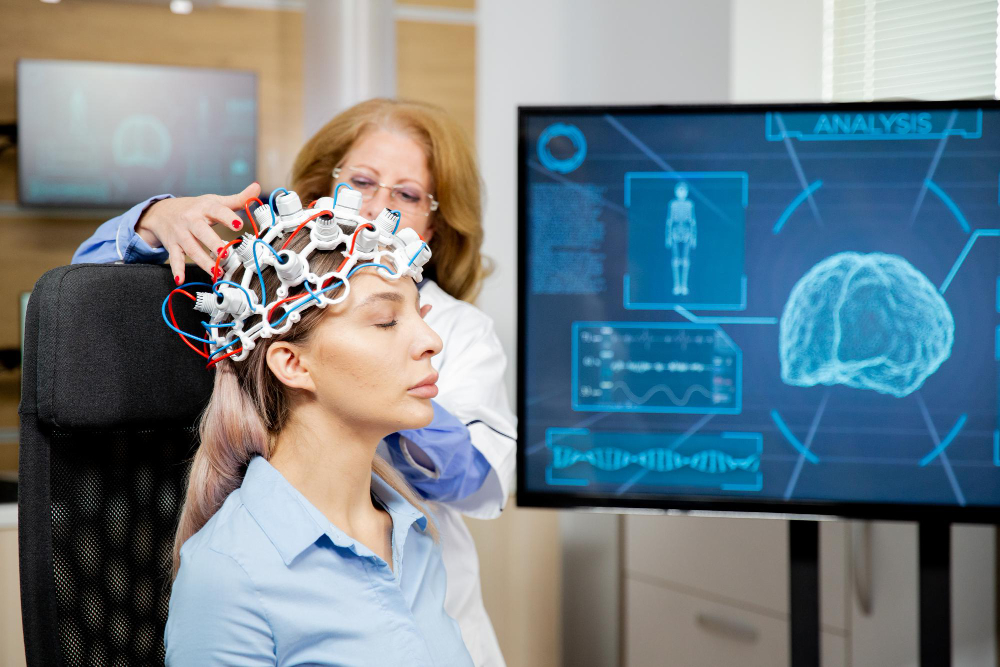
Many neurofeedback systems use EEG sensors placed on the scalp to monitor electrical activity. The sensors are designed to measure activity — they do not send electrical stimulation into the brain.
The information collected is then translated into feedback that you can see or hear in real time.
The goal is to give your brain an opportunity to recognize patterns and practice more effective self-regulation.
How Does Neurofeedback Work?
Think about learning any new skill.
When you are learning to play an instrument, improve your golf swing, or speak a new language, feedback helps you know when you are moving in the right direction.
Neurofeedback applies a similar concept to brain activity.
During training, brain activity is monitored while the system provides feedback — which may appear through visual changes, sounds, games, or other on-screen experiences, depending on the technology being used.
When certain targeted patterns occur, the feedback responds.
This creates a learning process in which the brain receives immediate information about its own activity.
With repeated practice, the goal is to strengthen the brain’s ability to regulate those patterns more effectively.
What Does “Self-Regulation” Mean?
Your brain is constantly adjusting to what is happening around you.
It helps determine when to focus, when to relax, how strongly to react to stress, and how quickly to shift from one state to another.
Self-regulation refers to the ability to adjust these responses appropriately.
For example, healthy regulation may involve being able to:
- Focus when a task requires attention
- Shift attention when priorities change
- Settle after a stressful experience
- Manage emotional reactions
- Transition between alertness and relaxation
- Recover more effectively after feeling overwhelmed
Neurofeedback is designed to provide information that can support this learning process.
Is Neurofeedback the Same as Brain Stimulation?
No.
This is an important distinction.
Neurofeedback is generally a training and feedback process, not a form of electrical brain stimulation.
In EEG-based neurofeedback, sensors placed on the scalp monitor brain activity so that the system can provide feedback about what is happening.
The sensors are listening to the brain’s activity rather than telling the brain what to do.
That is one reason neurofeedback is described as non-invasive.
What Can Neurofeedback Be Used For?
Neurofeedback has been studied in a variety of areas involving attention, cognitive performance, emotional regulation, and mental health.
Depending on an individual’s needs, it may be explored as part of a broader wellness or treatment plan for areas such as:
- Attention and concentration
- Stress regulation
- Emotional regulation
- Relaxation
- Cognitive performance
- Self-awareness and self-regulation skills
Research into neurofeedback continues to evolve, and outcomes can vary significantly between individuals and protocols.
It is important to think of neurofeedback as an individualized tool rather than a guaranteed solution for a particular symptom or diagnosis.
Does Neurofeedback Involve Medication?
No medication is used as part of the neurofeedback training itself.
For people who are interested in non-invasive approaches to brain training and self-regulation, this can make neurofeedback an appealing option.
However, “medication-free” does not mean that neurofeedback should automatically replace prescribed medication or other mental health treatment.
Decisions about changing or discontinuing medication should always be discussed with the appropriate healthcare professional.
Depending on the individual, neurofeedback may be used alongside therapy, medical care, lifestyle changes, or other forms of support.
What Does a Neurofeedback Session Feel Like?
Neurofeedback is generally an active learning process rather than a traditional talk therapy session.
Depending on the system being used, you may watch something on a screen, listen to audio, complete an activity, or simply observe changes in the feedback while your brain activity is being monitored.
You do not need to consciously “control” every brain wave.
Instead, the feedback provides information that allows learning to occur through repeated practice.
Much like learning any skill, neurofeedback is typically viewed as a process rather than a one-time experience.
Is Neurofeedback Right for Everyone?
Not necessarily.
Mental health and brain function are complex, and there is no single approach that is ideal for every person.
Your symptoms, goals, health history, current treatment, and individual needs all matter when determining whether neurofeedback may be appropriate.
That is why an individualized assessment is important.
A qualified provider can help determine whether neurofeedback fits into your overall care plan and what goals would be realistic for your situation.
What Does the Research Say?
Neurofeedback has been studied for decades, and research continues to examine its potential applications.
Studies have explored neurofeedback in areas ranging from attention and cognitive performance to emotional and behavioral regulation.
At the same time, research findings are not identical across every condition or type of neurofeedback.
Protocols can vary, and researchers continue to investigate which approaches are most effective, for whom, and under what circumstances.
This is an important part of responsible mental healthcare: recognizing both the potential of an approach and the limits of what current evidence can tell us.
Your Brain Is Constantly Learning
One of the most interesting things about the brain is its ability to adapt through experience and practice.
Neurofeedback takes advantage of that learning process by making otherwise invisible information about brain activity available in real time.
Rather than asking you to simply “try harder” to focus or relax, it creates an opportunity for the brain to receive feedback while practicing regulation.
For some individuals, neurofeedback may become one part of a broader approach to mental and emotional wellness.
Learn More About Neurofeedback Therapy at Redeem Wellness
If you are interested in improving focus, exploring emotional regulation, managing stress more effectively, or simply learning more about how your brain responds, Neurofeedback Therapy may be worth exploring.
At Redeem Wellness, we take an individualized approach to mental wellness and help you understand the options available based on your needs and goals.
Contact Redeem Wellness to learn more about Neurofeedback Therapy and find out whether it may be an appropriate option for you.